
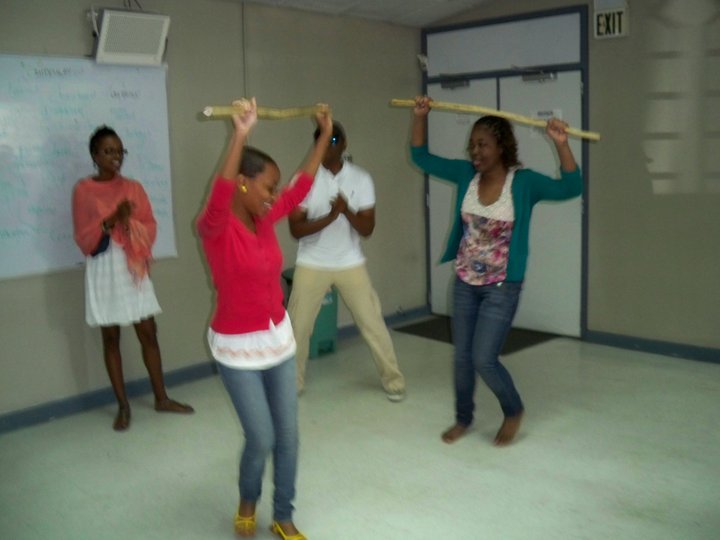
It was late June that year, and I was in DC for the Caribbean Carnival. One of the best in North America, my sources told me. My twenty-something year old son had urged me to go with him, “The music’s good, Mom! You’ll enjoy it!” So after a hiatus of over fifteen years, I was about to experience Carnival again, and with no small degree of trepidation.
Now, “back in the day,” as my son called my Carnival-going years, I used to memorize calypso lyrics to sing along in a fête. Calypsos, to me, were the gems of any Carnival. I saw them as masterpieces of linguistic artistry, even when riddled with humor, satire, biting social commentary or double-entendres. The mind of the calypsonian was a thing of beauty. These aficionados used to be as skilled at internal rhymes as Shakespeare was at iambic pentameter, and could compose extemporaneously and still maintain a jumpy rhythm. You used to be able to perform complex pelvic gyrations, known back then as ‘slow wine,’ while singing along with Sparrow’s endorsement of Barack, or King Austin’s observations about the nature of human progress. Time was when calypso lyrics, even when laden with racy double entendres, never failed to provoke deep thought.
But what I heard and saw at that erstwhile DC Carnival threw me into utter consternation. The calypso I knew and loved was now “vintage” or “Old School;” the faster variety, Soca, along with all its cross-pollinated pumpkin-vine cousins, was all the rage. Gone were the creative sobriquets, witty innuendos, and bitingly critical social and political commentary. Using their real names, soca artistes were now giving instructions within the song to revelers and masqueraders on where and how to move their bodies when negotiating each particular musical rendition. “Jump up, shake it, rock it, wine down, move to the left, now move to the right. . . .” My enjoyment now rested on perfect obedience and adherence to the baser herd instinct. To amplify my chances of eventual success, I like to be clear about what to do before attempting the task. I used to get punished for that as a child. But that was exactly how I approached this new millennium artform masquerading under the catch-all banner of ‘calypso.’ I had to understand.
Since I was especially intrigued by the terms “it” and “something,” which appeared with alarming frequency, my first task was to analyze the meanings of those two elusive concepts. When every linguistic aid proved unproductive, I resorted to algebra. Mathematical solutions never fail. Q.E.D. – Question Has Been Solved — I used to love that in school.
In one song, if such it can still be termed, everybody was instructed to “wave something,” in another, to “wine on something,” thus giving me two starting equations. from which to derive the unmask the identity of ‘something.’ A, x = Wave something, and B, x = ‘Wine’ on something. Equation A indicated that that “something” might be a flag, rag, even toilet paper or your child’s underwear if the singer’s performance was lackluster, as was supported by empirical evidence gathered at the scene. When I used the values already derived for “something” in Equation A, and substituted for “something” in Equation B, I arrived at ‘wine’ on a flag, rag, toilet paper, or child’s underwear, all of which shared the problem of improbability in execution. The act of ‘wining’ works best when performed with another person, but “wave somebody” was hardly possible.
I advanced to Equation C, x = Get something and wave, not to be confused with “wave something.” Equation C implied dual action — “get something,” and “wave.” While the subject, you, was understood, the object was not. “Something” was the object in “Get something,” but in “wave,” unlike in “wave something,” no object was necessary. Maybe the two main clauses were not connected at all.
The word “and,” that old conjunction function, held the key. The only relationship was in chronological sequence – first, “get something,” and then “wave.” Inverted order would have created severe complications. Wave first and then get something suggested a unidirectional causal relationship, in which case “something” could have been anything from the common cold to infamous HELPS. In fact, that made sense, because people with that “something” first would not be inclined to wave afterwards – not for long, anyway.
No nearer to clarity, I tried Equation D, x = Everybody doing something, which indicated present continuous action. This new equation defied the principles of both algebra and English grammar. “Something” had become a verb, not a noun, meaning everybody was flagging, ragging, toilet-papering, or child-underwearing. Thoroughly perplexed, I was back at Square One.
In desperation, I proceeded to “it” – as in “Wave it, shake it, turn it, jam it up, rock it, roll it”– to see what light, if any, solving for “it” could shed on the more profound mystery of “something.” My final equation was E, x = This party is it. Now, the term “it’’ in Socanese was used interchangeably with the term “something.” According to one youthful enthusiast, “This party is it,” and “This party is something,” both meant “This party is ‘da bomb.’” He was the expert. But I did my substitutions and proved him wrong. If the Bacchanalian masses were to wave, shake, or otherwise agitate such Weapons of Mass Destruction as ordered, there would be untold carnage.
I faced a dilemma. Perhaps “it” had a different meaning in each expression, like “wave your flag, shake your booty, turn your tail and run, jam up your toast, rock your boat, roll your Rs if you drift too far south of Key West,” or any combination or permutation of the above. But while I continued to analyze ad nauseam, it was my sycophantic informant, the soca connoisseur, with the illogic of youth on his side, who intimated that my underlying premise was wrong.
“In soca, and in Carnival, everything does not have to make sense,” he said. “Don’t think; just do! Suspend disbelief; just come lewwe get on bad!”
And, through the process of ‘stumble upon,’ I had my answer. “something’ was ‘anything’ as opposed to ‘nothing,’ and ‘it’ could become whatever you want that ‘something’ to be. By circumventing the empirical route, by burying the age-old philosophical arts of both deductive and inductive reasoning, I had arrived at the solution. Q.E.D. But in my fabled stubbornness I still hold out hope that regression analysis may yet help me determine the exact degree of correlation between mindless, frenzied activity and enjoyment of soca and, albeit, of Carnival. I am currently gathering data year-round at the numerous Caribbean Carnivals spawned across North America. By next Carnival I will have mastered the deep theoretical underpinnings of new millennium calypso.
KalyPsouL
YEAR-ROUND CARNIVALS IN NORTH AMERICA
January – Cozumel, St.Paul, Aruba.
February – Quebec, San Diego, Carriacou, Curaçao, Dominican Republic, Haiti, Little Cayman, Dominica, St. Martin, Trinidad and Tobago, New Orleans, Baton Rouge, Mobile, Martinique, Austin TX.
March – Miami.
April – Key West, St. Maarten, St. Thomas USVI, Grand Cayman, Jamaica, San Antonio TX
May – Atlanta, Orlando, Dallas, San Francisco, Tampa, St. Lucia, Grenada, Barbados.
June – DC, Philadelphia, St. Petersburg, Tampa Bay, Charleston SC.
July – Toronto, Houston, Montreal, Norfolk VA, Antigua, Tortola BVI, Camden NJ, Baltimore, St. Vincent, Cuba, Puerto Rico (Loiza).
August – Winnipeg MB, Boston, Jersey City, Calgary, Vineland NJ, Test City TX, Costa Maya, Anguilla, Chicago, Hamilton ONT, Springfield MA, Ottawa, Schenectady NY, Saba.
September – Brooklyn NY, Richmond VA, Long Island, Baltimore, Tallahassee, Chesapeake VA, Belize.
October – Miami, Los Angeles, Jacksonville, Fort Lauderdale.
November – Bayou.
December – St. Croix USVI, Nassau Bahamas, St. Kitts-Nevis, Montserrat.
The list is annually increasing as if by geometric progression.
 KalyPsouL@Large: Alien-Nation Reflections